Planning

IPMI & Member News

Concept of Online education. man use Online education
Enforcement Planning Sustainability Technology

On-Demand Education: Fundamentals of Parking & Mobility 101

Parking, transportation and mobility is an exciting profession that touches nearly everyone’s lives daily. This course is a foundation level course that will introduce topics such as customer service, communication, planning, parking regulations, enforcement and compliance, maintenance, sustainability and technology. This course is a perfect way to acquaint newly-hired parking and mobility professionals to the industry. Once all the modules are completed the end of course assessment appears. Those who score 70 percent or better on the assessment receive completion certificates.

Equity Beyond Capital - Susan Cole's Blog
IPMI Blog Leadership Planning Sustainability

Equity Beyond Capital: A Reflection on What True Inclusion Means

When we talk about equity in our industry, the conversation often stops at financial support. But “Equity Beyond Capital” challenges us to go further. It reminds me that true inclusion is about access, mentorship, and shared knowledge, things that can’t always be measured in dollars. I’ve seen firsthand how transformational it can be when someone takes the time to guide a small or diverse supplier through the process, explaining how funding works, what lenders look for, or simply helping them navigate contracts and certifications. That kind of support doesn’t just help one company succeed; it strengthens our entire industry. As leaders, we have a responsibility to make space for others to learn and grow. Sharing what we know, our templates, lessons learned, and even our mistakes, create a ripple effect that reaches far beyond one project or partnership. Equity also means creating a sense of belonging. When smaller firms are included in conversations, planning, and innovation, we gain new perspectives that push us all forward. Inclusion is not a charitable act; it’s a strategy for sustainability and innovation. I believe our industry’s future depends on how well we nurture relationships, mentor emerging businesses, and build systems that value knowledge as much as capital. Because when more voices are heard and more people are empowered, we all rise together. Susan Cole is the Founder and CEO of Cole Ticket Solutions (CTS). Susan can be reached at susan@coletickets.com.

Vector Illustration of various colorful cars parked in a parking lot top view.
IPMI Blog Parking Facilities Parking Lots Planning

The Public Service Shift – from Parks & Rec to Parking

Like so many others in the industry, my parking career began as a backup option. Having worked as a part-time supervisor while an undergraduate with Virginia Beach Parks & Recreation, followed by a stint with Raleigh NC Parks & Recreation after graduating with a degree in geography, I felt ready to take on any Park Management or Planner position in the southeast or mid-Atlantic. But the opportunity didn’t surface, and the monthly student loan payment couldn’t pay itself, so I took a parking facility management position with a private operator. That holiday season as a newly employed manager in the workforce I recall connecting with a college friend at a holiday party and seeing the confusion on his face when I mentioned the original goal of working in Parks & Rec yet embracing the opportunity in Parking. His response? “One is fun, one is not. So how long do you plan to stick around?” Down the road a few years later in a different parking role and city, I reflected on my work experience while also envisioning career growth and whether the Parks & Rec field remained a goal. I had a conversation with my previous supervisor in this role and she provided memorable input, to this effect of “parking may not be glamorous however there’s room for advancement and opportunities to be creative in this industry, and if you put in the time and dedication you will carve a serious niche”. Then I reflected on the parallels with Parks & serving the public and maintaining customer satisfaction, keeping facilities pristine, managing spaces, and partnering with other departments/organizations, among others. Do I regret my decision to remain in parking? Most days, no. I’ll also take dealing with periodic frustrated parkers over the daily animated skateboarding and dog park patrons any day of the week! Zach Pearce, PTMP, is an Associate Director of Operations for Old Dominion University. Zach can be reached at zpearce@odu.edu.

Two college students unloading belongings from a car trunk, excitedly moving into a new apartment and starting their independent lives
Data IPMI Blog Planning University

New Resident Student Move-in 2025

Every fall a new group of incoming students move into their dorms and call campus their home. We were approached by University Housing to assist them this past year with the logistics of parking and traffic control for the move-in of 4,500 new incoming students over the course of two days for the fall of 2025. In the past few years since COVID, the approach has been hands off from a parking standpoint. With occupancy of resident students increasing over the last few years traffic congestion, parking demand outpacing supply and frustrated drivers led to the need for a controlled and welcoming move-in experience. Thoughtful and strategic planning would be essential to our move-in experience success. Initial planning began with a high-level overview of what University Housing’s overall vision would be. Some of their needs included one-way traffic around the most populated dorms, express unloading zones, signage recommendations, and staffing of parking attendants to direct parking. Move-in 2025 was ultimately a success and there was positive feedback from those new students and families. Some key takeaways for success were planning logistically and communication. We started our logistics planning internally in February. This allowed enough time to decide what resources, signage and external parties were needed to be successful. We started communicating with stakeholders early in the process. We wanted the campus community to have realistic and clear expectations when students were moving in. University Housing took on the heavy lift of communicating plans through emails, meetings and social media. The week of move-in we started our setup with signage and barricades. This was a visual reminder for stakeholders as well. The last, and arguably the most important step in our planning process was to debrief and discuss lessons learned to improve the process. We met internally and with University Housing to discuss. Overall, move-in 2025 was a positive experience for those new students and their families and we are ready to start planning for 2026! Meredith Garrett, CAPP, is the Assistant Director of Public Safety, Parking & Transit Services for Kent State University. Meredith can be reached at mgarre12@kent.edu.

NACTO-Event
Curb Management Events Mobility Municipal/Cities Planning

Free Event: Curb Control: Building Modern Programs for Dynamic Streets

Join IPMI, OMF, and NACTO for a free industry webinar on managing the curb. As curb space becomes more dynamic, cities are evolving how they manage access, pricing, and competing demands at the curb. Open to all industry professionals!

Artificial Intelligence Processor Concept. AI Big Data Array
IPMI Blog Leadership Planning Technology

ChatGPT is a Tool, Not a Talent Strategy

In a world where generative AI tools have become so prevalent, they now serve a multitude of purposes, from writing emails to setting reminders to creating presentations. Yet a concerning and growing trend has emerged among organizations both large and small. Instead of prioritizing employee development, many have become dangerously obsessed with leveraging AI as a replacement rather than a supplement for their human capital workforce. This is where it becomes alarming at the organizational level, and why we must raise awareness before it spirals out of control. Employee development and generative AI are two distinct tools that serve very different purposes in our daily operations. Too often, I meet with leaders who say, “I’ll just have AI do it,” or “We can let ChatGPT come up with something,” when discussing new ideas or projects. The first question that comes to my mind is simple: Do you have anyone on staff who can actually move this project forward? Using AI is valuable, but eventually you will hit a roadblock, and that is where projects stall. More importantly, where is your next generation of talent coming from? Over reliance on AI breeds stagnation in the workforce, erodes institutional knowledge, and risks leaving organizations without the human capacity to innovate, adapt, and lead. The solution is not to reject AI but to use it responsibly. Instead of relying solely on AI, I suggest you exploit it through a simple framework: Integrate: Use AI to streamline routine, low-value tasks such as scheduling, document drafting, or data summarization. Invest: Reinvest the time and cost savings from AI into employee development programs. Innovate: Encourage teams to co-create with AI rather than outsource entirely to it. Leaders who strike this balance will future-proof their organizations while empowering the workforce that drives lasting success. Dr. George J. Mclean, MPA, DBA, PTMP, is the Senior Operations and Data Insights Manager for Miami Parking Authority. George can be reached at gmclean@miamiparking.com.


Finance Magazine Planning

Innovative Funding

What innovative funding mechanisms are emerging to support parking and mobility infrastructure in the face of declining traditional revenue streams?

Finance Magazine Planning

The Journey of a Parking Dollar

A Holistic View Reveals the True Cost of Your Parking Operation

An aerial view of the lines of parked cars. Heavy traffic in the parking lot. Searching for spaces in the busy car park. Cruising for parking in dormitory area. Difficulties of parking in the city.
Data Digital Parking Tech Enforcement Finance Legal Parking Facilities Parking Lots Planning Technology

Ungated Environments: Best Practices for Parking Payment Providers

As digital payments surge in ungated parking environments, ensuring clarity, consistency, and compliance has become more vital than ever. This white paper outlines key best practices for parking operators and payment providers to prevent consumer confusion and mitigate legal risk.

Bicycle parking
IPMI Blog Micro Mobility Planning University

Implementing University Bicycle Collections During the Summer Break

Summer bicycle confiscations at our University, and many others, serve as an annual project with the intention of removing all abandoned bicycles from students previously living on campus. Like many annual tasks and projects, I found this summer’s bicycle collection to be a terrific opportunity to update processes which involved internal and cross departmental collaboration.  This involved: 1)Examining a current policy and making updates to enhance the process identify and label all bicycle racks and changes to infrastructure, plot on a map Detail a tagging, removal, and storage process with a noted timeline, and identify staffing and equipment requirements 2)Create mechanisms for notification to the student and faculty/staff bodies, and  University departments physical tag serving as a notice with a removal date, with a timeline in the range of 1-2 weeks e-communications (University announcements, social media, mass emailing) share with Police, Student Affairs, Housing & Residence Life, Recreation, Athletics, etc. for awareness and promotion 3)Implementation List communication method(s) for students so bicycles are not erroneously collected; this can include a departmental main email address and/or phone number or a direct contact store the bicycles in a secured location accessible by the department and in an organized manner record all bicycles removed and placed in storage (make/model/color/serial number) store bicycles for determined length of time then remove (University approved auctions, donations, etc.) Bicycle collections help keep our campuses cycling infrastructure organized and accessible for future use, promoting non-vehicle commuting which we hope to see grow Zach Pearce, PTMP, is an Associate Director of Operations for Old Dominion University. Zach can be reached at zpearce@odu.edu.

Illustration of people holding hands and climbing a mountain taking a red flag to plant at the top.
Data Design Magazine Planning Technology

Leadership Development

What role does leadership development play in creating resilient, future-ready teams in our industry?

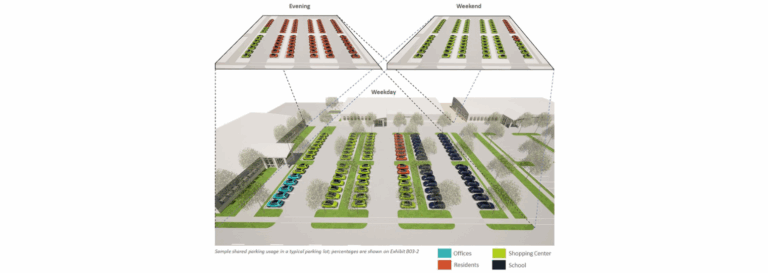
Shared Parking Usage Blog Photo
IPMI Blog Parking Lots Planning Sustainability

Shared Parking: Improving Urban Life

Shared parking is a key strategy in urban planning and development, offering innovative solutions to challenges like traffic congestion and inefficient land use. By maximizing the utilization of existing parking spaces, shared parking supports sustainability and improves the quality of urban life. Shared parking utilizes the same space for different parkers maximizing turnover and utilization of one space within 24 hours, minimizing unnecessary urban sprawl. Shared parking minimizes the need for expansive parking structures, freeing up valuable land that can be repurposed for green spaces, housing, or businesses. This promotes more sustainable, efficient land use. By maximizing turnover or utilization of existing parking spaces, shared parking reduces the need for new parking facilities, reducing the time drivers spend searching for parking. This will alleviate traffic, reduce emissions, improve air quality, providing a more sustainable and healthier environment. The parking consultant who specializes in calculating custom shared parking can reduce parking counts by 35% in some cases, encouraging Park Once and multimodal systems, resulting in fewer parking spaces, thus fostering creativity and flexibility for public spaces and urban design. Lia Reyes is a Managing Director and Sr. Principal Consultant for LVR International. Lia can be reached at lia@lvrintl.com.