DEI

IPMI & Member News

View of indoor parking garage through a car window being washed by a squeegee
DEI Magazine

Building Trust and Transparency in Parking Decisions

Few topics spark as much debate in a community as parking. Parking policy affects nearly everyone, influencing how residents live, businesses operate, employees commute, and visitors experience an area. Since parking decisions influence daily routines and access to shared spaces, even small changes can feel significant, and oftentimes personal. Building trust and communicating transparently helps ensure that new policies are understood, accepted, and ultimately successful. At its core, transparent parking management means that there should be no surprises. When people understand why parking policies are changing and how they will be affected, the result is stronger public support, smoother implementation, and better long-term outcomes for the community. Whether a municipality or agency is adjusting rates, introducing new time limits, or launching a digital permit management system, communication should begin long before any changes take effect. Providing ample notice gives community members time to prepare and ask questions. When it comes to enforcing new parking policies, a short “warning period” can help community members adjust as they learn the new system. This approach reduces frustration and demonstrates that the goal is education, not punishment. Reaching every audience requires a thoughtful combination of communication tools. Social media posts and digital newsletters can reach younger community members and tech-savvy audiences, while printed flyers or mailed notices remain effective for older generations or those who are less engaged online. Frontline staff, such as enforcement officers, can also play a meaningful role by distributing flyers and answering questions directly, reflecting a community-oriented approach to parking enforcement. These personal connections often go a long way in building trust and ensuring the message reaches everyone. Equity should remain at the center of every outreach effort, as not all residents have reliable internet access or feel comfortable using digital platforms. Offering multiple ways to receive information, ranging from online updates, mailed notices, in-person conversations, and community meetings, can help bridge the digital divide. Hosting meetings outside of regular work hours, providing language translation services, and ensuring that venues are accessible make it easier for everyone to participate and share their perspectives. When a municipality or agency is leading a community outreach effort, there should be emphasis on leveraging partnerships with neighborhood associations, including Chambers of Commerce, homeowner associations, and advocacy groups, to further strengthen communication. These networks already have the trust of their communities and can help share accurate information, gather feedback, and identify potential challenges early in the process. A transparent and inclusive outreach process helps ensure that parking decisions reflect the needs of the entire community, not just the most vocal groups. By prioritizing open communication, accessibility, and equity, municipalities and agencies can shift the perception of parking programs from confusing or punitive to collaborative and community-driven. Ultimately, parking management is about people as much as it is about policy. When residents feel informed and heard, they are more likely to view parking programs as fair, accessible, and aligned with broader goals of improving mobility and quality of life. Building that trust not only enhances compliance and safety but also contributes to stronger, more connected, and more supportive communities.

Older gentleman at a parking kiosk
DEI Leadership Magazine

Rage, Ignorance, Excuses, and the Status Quo: Parking Needs a Reckoning

Why cities must stop circling the issue and start rethinking the role of parking in public life

Meeting of professional people around a table
DEI Magazine

More than Good Intentions

The Evolving Role of Employee Resource Groups

Teal hexagons connecting icons of EV charging stations, parking apps, mobile devices, cloud storage, parking meters
DEI Digital Parking Tech Magazine Technology

Parking’s Next Era

Digital Platforms that Power Efficiency and Equity

Beautiful image of a large sunflower in front of a background of sunflowers, and a drawing of a silhouetted face
Accessibility DEI Magazine

The Sunflower Program

Recognizing Hidden Disabilities Across Parking Operations

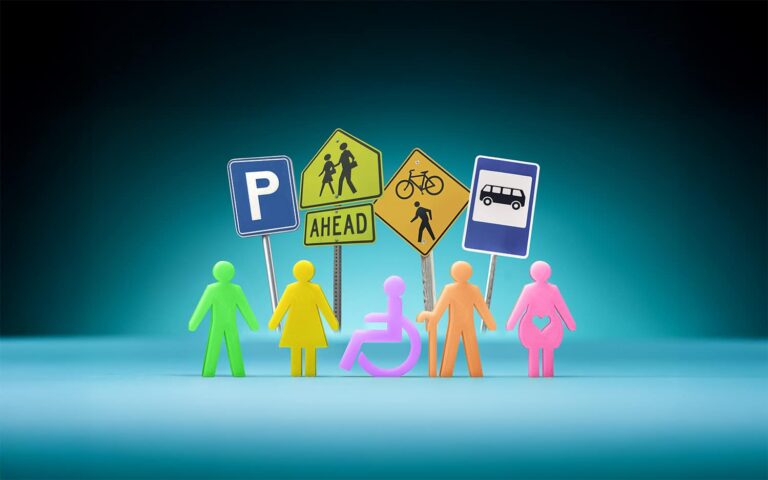
Colorful plastic silhouettes in front of common street signs
Accessibility DEI Magazine

Building Belonging

A community is only as strong as its ability to include everyone.

Double long bus with a "Go Texans" banner on the front marquis, on a summer day with green trees in the background
Accessibility DEI Magazine Municipal/Cities University

Transportation Equity in Motion

Why Parking Matters

Futuristic handshake symbolizing digital connection. Blue with a black background
Accessibility DEI Magazine

Digital Allyship

Reclaiming Mobility for Transportation Equity

Teal "Ask the Experts" graphic
Accessibility DEI Magazine

Accessibility & Transportation Equity

How do we ensure that parking and mobility decisions reflect the needs of every person, not just the majority of users?

Businesswoman talking to colleague with hand on shoulder in supportive gesture at corporate workspace
DEI Magazine

More Than a Space

Building Equity in Parking Workplaces

Allyship & Equity group of diversity
DEI IPMI Blog

The ROI of Diversity

Diversity and inclusion aren’t just moral goals; they’re revenue levers and public service musts. Companies with diverse leadership teams innovate faster and achieve higher returns. Public agencies produce better policies and have increased community trust.  A McKinsey study showed companies in the top quartile of diversity efforts were 36% more likely to outperform their peers in profitability, and those with gender-diverse leadership had a 25% higher likelihood of above-average profitability. BCG ties diverse workforces to 19% higher revenue due to increased innovation. Study after study asserts that investment in diversity provides high ROIs.  In government, inclusion strengthens operations and trust. A 2022 report by the Partnership for Public Service and Deloitte showed that federal agencies with higher inclusivity and engagement scores had stronger workforce performance, better retention, and more effective service delivery. When institutions mirror their communities, they craft fairer policies, enhance public trust, and make better product and service decisions. Diversity is broader than gender and race: it spans military status, age, education, religion, physical and cognitive abilities, language, parental status, and socioeconomic background—differences that fuel diversity of thought. In parking and mobility, this looks like alternate and phone payments, pay-by-cell, Accessible Pedestrian Signals, multilingual signage, citation payment plans, video hearings, and reduced fees for veterans. Talent markets demand this. Glassdoor finds 76% of candidates value a diverse workforce. Deloitte links inclusion to 2.3 times higher cash flow per employee, greater change-readiness, and lower attrition.  The takeaway is clear. Diversity is a revenue driver, risk mitigator, and competitive edge, and embracing it is simply smart business.  Click here to read the Parking & Mobility magazine article. Madison Huemmer is the Head of Market Transformation for ParkMobile by Arrive. Madison can be reached at madison.huemmer@arrive.com.

DEI Magazine

The Business Case for Diversity

Why Inclusive Organizations Outperform