Blogs

IPMI & Member News

Shared Parking Usage Blog Photo
IPMI Blog Parking Lots Planning Sustainability

Shared Parking: Improving Urban Life

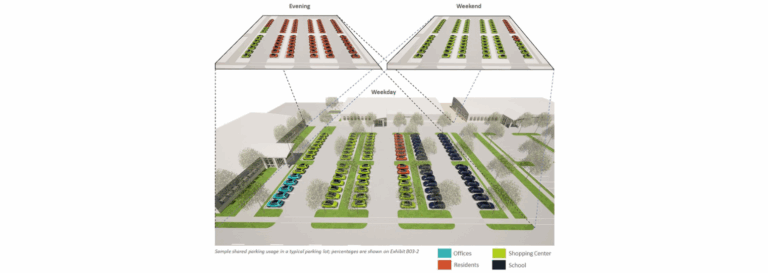
Shared parking is a key strategy in urban planning and development, offering innovative solutions to challenges like traffic congestion and inefficient land use. By maximizing the utilization of existing parking spaces, shared parking supports sustainability and improves the quality of urban life. Shared parking utilizes the same space for different parkers maximizing turnover and utilization of one space within 24 hours, minimizing unnecessary urban sprawl. Shared parking minimizes the need for expansive parking structures, freeing up valuable land that can be repurposed for green spaces, housing, or businesses. This promotes more sustainable, efficient land use. By maximizing turnover or utilization of existing parking spaces, shared parking reduces the need for new parking facilities, reducing the time drivers spend searching for parking. This will alleviate traffic, reduce emissions, improve air quality, providing a more sustainable and healthier environment. The parking consultant who specializes in calculating custom shared parking can reduce parking counts by 35% in some cases, encouraging Park Once and multimodal systems, resulting in fewer parking spaces, thus fostering creativity and flexibility for public spaces and urban design. Lia Reyes is a Managing Director and Sr. Principal Consultant for LVR International. Lia can be reached at lia@lvrintl.com.

loyalty and related words
Community IPMI Blog Planning

IPMI 2025 Recap: Shifting the Industry Paradigm Toward Rewards

Parking has a reputation problem. Many motorists perceive parking as penalizing, confusing, and expensive. That perception has persisted for over a century, dating back to the earliest parking meters and tickets. And while parking management technology has advanced tremendously in that time, enforcement models have remained largely unchanged. Other industries have made notable strides in improving the customer experience. Airlines offer miles. Car insurance companies reward safe driving. Banks and credit card companies provide cashback and loyalty perks. The list goes on. Over time, these industries have helped influence positive consumer behavior by establishing trust and long-term customer relationships. Parking can draw inspiration from these industries. At IPMI 2025, leaders from Park Loyalty and RISETEK presented a packed session exploring customer loyalty programs for parking. How can the parking experience reward compliance? What if local businesses gained new ways to engage customers? Picture this: a driver pays to park and receives a coupon from a nearby café. Or they earn a small perk, like a discount on dry cleaning, just for consistently following parking rules. Even parking tickets could become less painful if timely payment leads to a future discount. These simple ideas can shift public perception of parking, promote compliance, and foster new community connections to local businesses. This model introduces a “value triangle” between agencies, drivers, and merchants. Everyone contributes, and everyone benefits. Cities and universities see better compliance. Motorists feel appreciated. Local businesses attract more visitors. This isn’t just a concept. Modern parking platforms can support these strategies. Programs can be agency-branded, tailored to local needs, and integrated into existing systems without disrupting enforcement or revenue. The future holds that parking can still be fair and well-managed while building trust instead of resentment. Full recap: https://parkloyalty.com/parking-rewards-changing-enforcement-for-better-compliance/ Julia Scholl is a Marketing Manager for Park Loyalty. Julia can be reached at julia.scholl@parkloyalty.com.

Louisville Blog picture - how to say "Louisville" many ways
Community Data Events IPMI Blog Technology

What We Learned at IPMI 2025 - Data, Drones, and Game Day Drama

The International Parking and Mobility Institute (IPMI) Conference is always a chance to spot what’s next in parking and mobility (and maybe a little of what’s not working yet). This year was Peter Richards' 5th year attending (and 1st since he founded Parkicity), and it delivered everything from live drone feeds at NFL stadiums to lessons on permit data pitfalls. Here are a few key takeaways from IPMI in Louisville. I've been saying it wrong all this time! Permits, Pilots, and Parking Near Stadiums On a tour near the Louisville City FC soccer stadium, we heard about a Residential Permit Parking (RPP) program that was launched - and then quickly shut down - because residents said they weren’t notified. But they were. The area, once home to a car junkyard, now hosts 2,200 gravel lot spaces and has big redevelopment plans for retail and apartments. But enforcement and event planning challenges remain. People park for free far from the stadium, and attempts at event programming (like concerts) have literally torn up the turf. It should also be noted that Louisville is a multi-vendor paid parking app, meaning visitors have the choice of their favourite app. Pick an app, any app From LPR to Insight: The Dirty Work Behind Clean Data A major thread at the conference was data and how to collect occupancy, 24/7 or periodically. One presentation highlighted the benefits but also the complexity of turning license plate recognition (LPR) and camera data into useful information. The raw feeds - LPR scans, citations, permits, payment transactions, even drone images need serious cleanup: Enforcement schedules can skew what’s captured Sensor coverage is patchy, especially beyond pay stations License plates need fuzzy matching (is that a Z or a 2?) Metadata like vehicle type or duration is often missing Privacy measures must anonymize plates before analysis One theme emerged: “Data should inform decisions, not lead them.” Cities need “before and after” metrics - occupancy, permits issued, citation volume, and compliance - to prove that a permit or pay program solves an actual problem. Hayes Valley’s “Pay or Permit” program in San Francisco came up as a model, built on three pillars: Most parkers aren’t local Most non-residents are overstaying Occupancy is consistently high Toronto’s Parking Tech and EV Future The City of Toronto shared its evolving mobility landscape - and how parking is still part of the story. A few standout stats and ideas: One lot near Spadina added Purolator parcel lockers and increased revenue by 33%. Multi-functional lots add value 50% of EV charging users lived within 1km of the charger, 57% of users live within 5 km They’ve processed 50,000 new EV transactions Long-term goal: reduce from 3,100 to 2,000 meters - but keep them for the next decade One big idea or dream floated by the TPA VP of Operations: a future monthly bundle for parking, transit, and bike share access. Not here yet - but the bundling / Mobility as a Service joint offering conversation is getting louder. Digital Curb Challenges from Seattle to Boston Cities are still figuring out how to digitize the curb. A few shared challenges: Cameras are tricky to deploy due to mounting, power, and departmental silos Cyclomedia and Cartegraph are used in Boston, but 20% of signs were missing from digital records Trucks and passing vehicles can feed false data into sensors or AI Even with real-time availability, Minneapolis noted delivery drivers likely wouldn’t use this information - routes, schedule, and habits matter more Seattle’s commercial load zone data showed 80% of vehicles were parked illegally, underscoring that enforcement is essential - especially for small businesses that rely on load zones for survival. It was stressed that the management of these commercial loading zones is a key factor to the value of the permit and if they would actually buy the monthly permits Seattle released the CurbIQ digital curb inventory and real-time information of these load zones, and it's super cool: https://seattle.curbiq.io/public-default/ Brian Hamlin from Seattle DOT showing up their real-time public map link NFL Game Day Parking is a Logistics Masterclass Walter P Moore walked us through the logistics of managing 26,000 spaces on NFL game day at the Houston Texans' NRG Stadium: 21,000 spaces are used by fans, the rest for staff, media, and other “back of house” roles Rideshare lots, pedestrian plans, and cashless mobile passes are all part of the playbook “Eyes on approach and egress” with roaming vehicles is key Staff use active guidance to manage entry and exit flow Most fans are parked 15 minutes after kickoff, and the lots are cleared within 1 hour after the game Could Parkalytics and their drone parking surveys support live feed monitoring or drone mapping here in the future? Something for event management planners to consider. Ushering in the New Curbside Management Era: How to Transition from Parking to Curbside Management The Curb Super Group! This municipal workshop was led by experts from Minneapolis, Miami Parking Authority, Washington DC, Fairfax County, City of Richmond (and Parkicity), and centered around various burning questions and issues municipalities are having at the curbside, from policy and regulations, to simply digitizing and mapping their curbs. Despite various sized municipalities, the issues were similar - staffing, budgets, politics, prioritization, coordination, data ownership, and communication Cities want to digitize their curb, but need internal champions Solutions discussed included budgeting for curb-related digitization and studies, using software to aid the process, and starting small with pilots Final Thoughts There’s no single path to modern curbside management, but the ingredients include items such as strong data foundations, clear goals and objectives, city buy-in from top to bottom, smart tech applications, and responsive operations. Open Mobility Foundation bike ride Have questions on any of these takeaways or want to test out some of these strategies in your city? Let’s talk. Peter Richards, P.Eng., is the President and Principal Consultant for Parkicity. Peter can be reached at pete@parkicity.com. This blog is republished with permission from Parkicity: https://www.linkedin.com/pulse/volume-8-what-we-learned-ipmi-2025-data-drones-game-day-drama-5jxjc/  

Conference Photo Blog
Community Events IPMI Blog

The IPMI Conference: A Familiar Ride with New Thrills

Every year, heading to the IPMI Conference feels a bit like getting in line for a roller coaster for me. There’s that initial moment—right before it all begins—where you wonder how it’s going to go. You’re excited, sure, but there’s also that quiet buzz of nerves in the background. Then you arrive. You start bumping into familiar faces—old friends, colleagues, people you’ve only seen through the computer screen for the past year. Conversations start flowing, and before you know it, you’re in the groove. The energy of the event takes over. You’re swapping ideas, learning from others, and soaking in the buzz of the expo floor where vendors are showing off new technology – and a tiny horse, did anyone see that too?! Just when you’re feeling fully at home, it’s time to present. The nerves creep back in—but this time, they’re different. You and your co-presenter step up, deliver your session, and walk away knowing you nailed it. That’s a high that’s hard to beat. The whole experience is a whirlwind—ups, downs, adrenaline, inspiration. It’s a reminder of why we do what we do. You leave feeling energized by the new connections, the fresh ideas, and the sense that you’re part of something bigger. Sure, there’s never enough time to see and do it all, but that’s part of the magic. We come together at IPMI not just to learn, but to grow—together. And every year, that ride is worth it. Nick Mazzenga is a Parking Technology Consultant for Kimley-Horn & Associates, Inc. Nick can be reached at nick.mazzenga@kimley-horn.com.

Online education e-learning internet lessons Seminar via online website Studying abroad, distance conferencing, online education technology, teaching videos and internet lessons.
Digital Parking Tech IPMI Blog Technology

Webinar Key Takeaways: A Decade of Parking Technology - Predictions, Progress, and Future Needs

Over the last decade, parking technology has evolved at a faster rate than in any other period of history. The IPMI Technology Committee has been there every step of the way, helping the parking and mobility community navigate through the lightning-fast changes. This session took a retrospective look at the evolution of parking technology by revisiting our past Technology Committee presentations, exploring how various parking technologies were developed, identifying the catalysts that facilitated their adoption, and the barriers that hindered others.

Member Roundtable chats
Community Design Development IPMI Blog Parking Facilities Planning

Roundtable Key Takeaways: Designing For Future Operational Flexibility

IPMI’s Planning, Design, and Construction committee hosted a member roundtable focused on parking-related design and construction trends, including commercial real estate market costs and technologies that affect how garages and PARCs systems are designed.

Connection together puzzle pieces.
Digital Parking Tech Enforcement IPMI Blog Technology

Built to Integrate: Why Parking Tech Needs to Work Together

If there’s one thing the UK parking sector has taught me, it’s this: the best technology doesn’t work in isolation. When systems speak to each other, from cashless platforms to ANPR to enforcement tools, the result is a smoother journey for the user and far less friction for the operator. But here in the US, I’ve noticed that this kind of integration isn’t always the norm. In fact, many parking operations are being held back by siloed systems that don’t share data, don’t connect, and don’t evolve. It’s time to change that. The Challenge of Disconnected Systems Over the last decade in the UK, I’ve witnessed a quiet revolution in how parking tech works behind the scenes. Operators moved from clunky, standalone tools to integrated platforms that unify enforcement, payments, permits, and reporting. And the benefits were immediate: reduced manual input, fewer disputes, better compliance rates, and, crucially, an improved user experience. Since working in the US, I’m hearing familiar stories of fragmented workflows. A motorist pays to park via one app, but that data doesn’t flow through to the enforcement team’s handheld device. A permit is issued in one back office, while citations are managed in another. Operators are stuck manually reconciling systems that should be working in concert. This isn’t just inconvenient, it’s operationally risky. Disconnected systems can lead to erroneous enforcement, a poor public perception, and significant resource drain. As enforcement becomes more complex and user expectations rise, it’s no longer enough to have ‘good enough’ systems. They have to work together and be able to be configured. The Power of an Integrated Approach Achieving seamless integration isn't merely about adding a new feature to existing software; it's about adopting a fundamental shift in how parking operations are conceived and managed. It means moving towards open, configurable systems that prioritize interoperability. This approach allows operators to connect various existing tools and data sources, rather than requiring a complete overhaul. The goal is to create a cohesive ecosystem where all components communicate effectively, optimizing efficiency and accuracy. Why This Matters for the US As US cities and private operators modernize, there’s a real opportunity to leapfrog the fragmented model and move straight to smart, connected systems. Integration-ready platforms don’t just manage enforcement — they enable better collaboration between data sources, departments, and vendors. From the curb to the control room, the value of a unified system is hard to ignore: fewer errors, better accountability, and systems that scale with your operation, not against it. And as we look ahead to the 2025 IPMI Conference & Expo in Louisville, I’m excited to be part of that conversation in person. I’ll be there with Unity5, ready to meet US operators, technology partners, and anyone interested in making their parking operations smarter, not harder. If your systems aren’t speaking to each other, or worse, if they’re speaking different languages, it might be time to rethink what your tech should do for you. Because in parking, as in life, the best results come when we work together. Hannah Fuller is the Director of Commercial Strategy and Partnerships for Unity5. Hannah can be reached at hannah.fuller@unity5.com.

Flexibility and adaptation concept.
HR IPMI Blog Leadership

Adaptability and The Team

As a Parking Operator, we pride our team on the ability to adapt over time and to be flexible with an ever-changing environment. Whether due to advances in the technology related to our parking operations or due to more specific needs and directives over time, we flex with the needs of our stakeholders. From the hiring process through training and development, we try to cultivate this concept with our teams and enrich in employees this sense of being flexible. Providing the team with project specific goals, to assist all to understand the soul of the project, we can try and help the team to understand the importance of adapting. Presenting those who may not like the idea of change with opportunities to experience more facets of the operation, to give employees the opportunity to see more than what is presented to them as the baseline of their job, we may enlighten and create more open-mindedness to change. We also pride ourselves that we have a dedicated and long-standing staff, who have seen change first hand, multiple times, and have adapted as needed to maintain value for the operation and for the self. For whatever reason that any individual may assign their self adaptability as their skill, we as leaders nurture that and lead by example. Adam Feller, PTMP, is an Operations Manager for LAZ Parking. Adam can be reached at Afeller@lazparking.com.

Hands holding a paper head with a human brain with flowers, self care and mental health concept, positive thinking, creative mind
IPMI Blog Leadership Mental Health

Let’s Talk About It: Mental Health in the Parking and Transportation Profession

Mental health is a topic we don’t talk about nearly enough, and when we do, it’s often behind closed doors—if at all. There’s still a stigma around acknowledging stress, burnout, or emotional fatigue at work. Many professionals worry that being open about their mental health will make them seem less capable or limit their career growth. I’ve felt that hesitation too. But if we keep avoiding the conversation, we risk doing real harm to ourselves, our teams, and our organizations. That’s why I wrote the article featured in this month’s Parking & Mobility Magazine. It explores the mental health challenges faced by everyone in our industry—from frontline employees and enforcement officers to business professionals navigating high expectations and constant change. In the article, I share strategies that can help—things like peer support, mental health training, wellness programs, and leadership practices that make space for real conversations. I also highlight voices from the field who are already doing this work and pushing for change. Mental Health Awareness Month is a perfect time to talk about this. But it can’t be a once-a-year topic. If we want healthier, more resilient teams and better service for our communities, we need to make mental well-being part of our everyday culture. I hope you’ll take a few minutes to read the full article—and maybe start a conversation of your own. Victor Hill, PTMP, is a mobility and parking consultant at Walker Consultants and a member of IPMI’s certification board. He can be reached at vhill@walkerconsultants.com.

Hand holding Zen stone with Gratitude text engraved on the stone.
IPMI Blog Leadership Mental Health

Gratitude

A great man once said that the best currency, the most valuable of all, is gratitude. I believe that the groundwork that’s been laid in the world of parking, the innovations that continue to develop, the people and mentors that have been beacons for others, make this industry a great place to work. Parking means more than just a place to park a car due to the passion and dedication of a good many folks. When our leaders have the vigor to see the industry succeed and continue to succeed for the vast network of folks who are affected by this industry, we are thankful we can also provide the same energy for the folks that we individually affect day to day. During times of challenges and new opportunities, gratitude can provide a sense of grounding, to help us relate to what may be unknown to us, to think outside ourselves. Often times we need this strength to be strong for others, even if we are not feeling that confident ourselves, that gratitude can establish as a tool in the box. Technology changes in the parking world can affect our strategy year to year and we need to continue to adapt with it. To remember this gratitude, this thankfulness of all those who helped us grow up to this point, we are better adept to provide the same leadership for the people who need a little help in the now. Adam Feller, PTMP, is an Operations Manager for LAZ Parking. Adam can be reached at Afeller@lazparking.com.

Online education e-learning internet lessons Seminar via online website Studying abroad, distance conferencing, online education technology, teaching videos and internet lessons.
Data Digital Parking Tech Events IPMI Blog Parking Facilities Parking Lots Transit University

Webinar Key Takeaways: Parking Mitigation Strategies

How did Princeton evolve to meet the new demand for parking? With a multi-pronged approach, they integrated cutting-edge technology, incentivized alternative commutes, and rolled out transit programs, all while maintaining operations on a 275+ year-old campus amidst major construction. Join the Princeton University team as they showcase how data can drive smarter decisions, ease parking stress, reduce congestion, and ultimately improve the campus experience. 

Compliance Related Words Written on Wood Blocks Sitting on Wood Surface
Curb Management Enforcement IPMI Blog Policy Technology

Policy Corner

The IPMI Policy & Legislative Cohort administered a survey aimed at identifying the most pressing industry policy topics.  Among the top issues are policies around new technologies that could revolutionize parking management by reducing friction. One of the highest friction points in an operation is the ability to consistently facilitate curbside compliance, aka parking enforcement.  As curbside demands have exponentially increased, the parking enforcement tools in our policy toolbox have generally remained the same. I’m not here to write about the legislative barriers to reduce friction in the parking enforcement process (there are many) or the growing number of case studies of cities that have embarked on their automated enforcement journey (that number is growing).  What I’m here to write about today are the policies that your organization should be thinking about when you are able to reduce the friction in your parking enforcement process and move towards automated enforcement.  Before we begin, what do I mean by automated enforcement.  For the purposes of this discussion, automated enforcement is the ability to utilize fixed or mobile camera technology to identify a parking violation and process that parking violation without placing a parking citation on the violating vehicle. Imagine for a minute your organization has the legislative ability to implement automated enforcement.  Would you be able to implement by the end of the week, month, year?  Here are just a few policy topics your organization should think about when moving towards automated enforcement: Violation Types – does it makes sense to automate enforcement for all violation types? Are there more severe safety related parking violations that should be prioritized for an initial rollout of automated enforcement? Payment/Appeal Deadlines – mailing a parking citation to a registered owner adds time to the notification process. Do your payment and appeal deadlines need to shift to accommodate this new process? Violation Fine Structure – cities that have implemented automated enforcement have seen citation issuance increase exponentially. Knowing this may occur, are there opportunities to revise the fine structure for certain violations? This may be an opportunity to introduce first-time warnings, early payment discounts, or progressive pricing for repeat violators. Don’t get me wrong, the legislative framework to allow for automated enforcement is a top priority to enable your organization to leverage new and emerging parking enforcement technologies.  Equally as important is your policy framework for administering an automated enforcement program. Policies matter, and when developed in a comprehensive manner can lead to long-term success for your operation.  Let’s keep the conversation going on Forum Online Community and the dedicated “Policy and Legislation” community. Robert Ferrin, PTMP is a Mobility & Parking Senior Project Manager with Kimley-Horn & Associates, Inc. and is serving his third term on the IPMI Board of Directors.  Robert can be reached at robert.ferrin@kimley-horn.com.